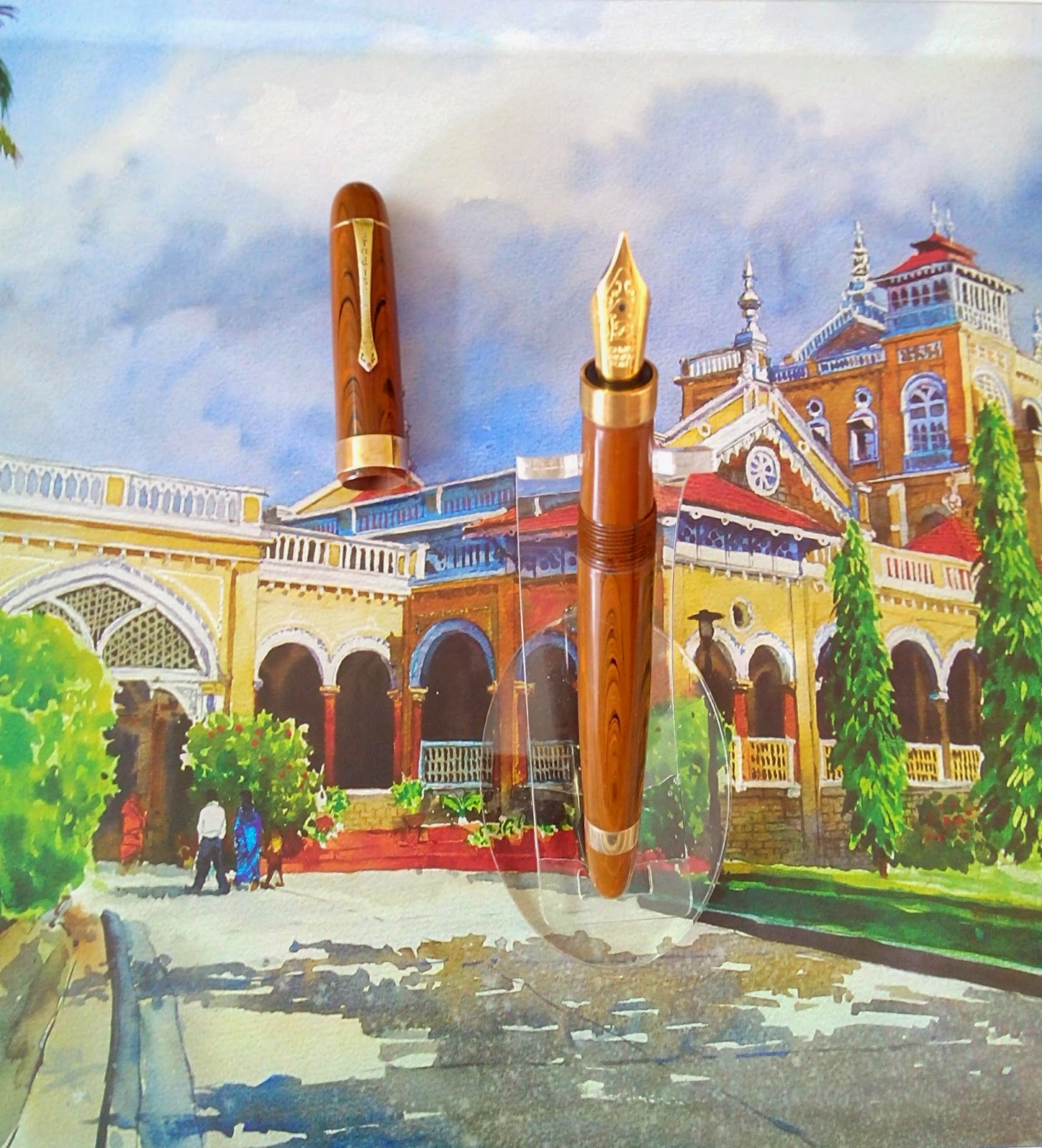
I like challenges and when Sanjay from Bangalore approached me to make a triangular pen, I gladly accepted the challenge.
All of my pens are made on a manual lathe machine which can only turn round shapes. In order to make the triangular shape on a lathe, it required some innovative thinking and a lot of R&D (essentially trial and error). After a few failed attempts, I was able to get the accuracy I wanted so that I can produce a pen that somebody would want to pay for.
Here is the very first Fosfor Tikona:


Tikona or actually Trinoke means a Triangle. There is also a hill fort near Pune which bears the same name Tikona and is actually pyramidal in shape. Although the pyramid is missing from this pen, the triangular shape is very much prominent. If the ends of the pen are brought together, we will get a three faceted pyramid, however it is difficult to achieve.
For the first pen I made, the barrel does not have threading for the cap, but instead the grip section has threading which secures the cap. There are a couple of reasons for this design aspect: 1) the shape of the pen appears to be more unified starting from the section; 2) it is possible to have smaller diameter threads for the cap so that the base of the cap can be thin and 3) it allows for a longer section than usual so that the triangular edges of the barrel don't interfere while holding the pen. The section is secured onto the barrel using an O-ring so that while unscrewing the cap, the section is not removed inadvertently.
The making of this pen does require lot more manual work especially in getting the triangular alignment right and then while polishing the pen. All of the polishing has to be done by hand and those who make hand-turned pens would know how time-consuming it can be.
I was convinced that this experiment was successful when I received this note from Sanjay:
"Friends are awestruck at the beauty of it
Everyone thought it was impossible and u pulled u r magic card out and blew everyone away
I am still amazed by fit finish and the cap aligns perfectly on line with the barrel.
Thanks a Ton literally mean it"